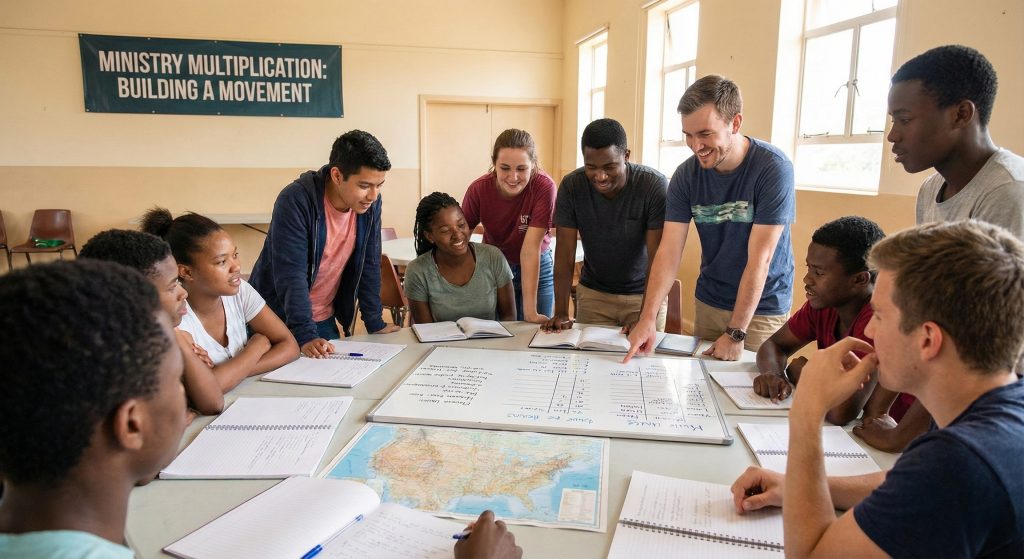
Ministry multiplication in youth ministry is not reserved for unusually gifted leaders or unusually large churches. It is what happens when the Gospel becomes the driving force, when students are activated to live out prayer, care, and share rhythms, and when leaders model a lifestyle they hope their teenagers will imitate. For many ministries, that kind of movement begins when they shift from addition to multiplication and embrace a Gospel Advancing approach.
If you have ever wrapped up a ministry year and quietly wondered, “Why didn’t much change?” you are not the only one. Many youth leaders feel that tension. The encouraging news is that there is a clear, biblical, research-supported pathway toward something better. A path that leads to genuine spiritual momentum, contagious Gospel conversations, and disciples who make disciples.
This is what ministry multiplication looks like. And it is far more achievable than you might think.
Why last year felt like more of the same
Some years end with moments that feel encouraging and hopeful. Other years leave you with a quiet realization that, despite your best efforts, the deeper results stayed remarkably similar. You tried new things. You added creative elements. You showed up consistently in students’ lives. Yet the ministry outcomes resembled the year before.
Often, the issue is not how hard you worked. It is what the work was building. When ministry operates on addition instead of multiplication, the path usually leads back to familiar outcomes. Dare 2 Share’s A Generation in Reach study found that typical youth ministries, those that do not consistently train and mobilize students, tend to gain fewer than five new students a year. Multiplying ministries often see fifteen or more, and many of those students are new believers introduced to Jesus by a friend.
What ministry multiplication actually looks like
Multiplication has a feel to it. Students begin praying for friends by name. Gospel conversations surface in small groups without prompting. Leaders start hearing stories rather than excuses. New believers are discipled, and then they begin discipling others. Momentum builds, not because you are pushing harder, but because students are carrying the mission into places you could never reach alone.
Multiplying ministries often see students discussing who they are praying for and what conversations they have had. Leaders share authentic stories from their own lives. Growth begins to come from Gospel conversations rather than attendance-driven events.
Culture creates multiplication; programs don’t
Programs create moments. Culture creates movement.
A powerful retreat can inspire students for a weekend, but culture shapes them the following Wednesday, the next month, and even the next year. When a ministry’s culture values prayer for the lost, celebrates spiritual risks, and treats Gospel conversations as normal, students begin assuming that the mission belongs to them too.
Culture works quietly. It whispers what matters. It reinforces what is expected. It shapes how students talk and what they pursue.
Programs are tools. Culture is the environment where those tools take root. If you want to build a strong and healthy youth ministry culture that fuels long-term multiplication, you can explore our full guide here.
How student-led evangelism fuels ministry multiplication
Students reach other students more effectively than anyone else. A teenager’s voice carries credibility and connection that adults cannot replicate. When a student shares the Gospel with someone they care about, the conversation often lands with surprising openness.
One step of courage can create a chain reaction. A student shares with a teammate. Another prays with a friend. Someone else starts a spiritual conversation at lunch. As these moments multiply, the ministry expands outward through relational pathways adults may never see.
Research confirms this pattern. Ministries that consistently train students to share their faith experience three times more students actively sharing the Gospel and ten times more Gospel conversations per sharing student. Many of those conversations lead to students placing their faith in Jesus.
Why leaders must model multiplication first
Teenagers learn by imitation. They watch the way you follow Jesus more than they listen to your teaching about following Him. When leaders talk openly about the people they are praying for, share stories of Gospel conversations, whether smooth or awkward, and take spiritual risks in their own relationships, students begin to see evangelism as a normal part of discipleship.
You do not need to be an expert evangelist. Students need authenticity more than polish. They need to see leaders who genuinely care about lost people and trust God enough to step into spiritual conversations.
A Gospel Advancing blueprint for your ministry year
Multiplication does not grow from guesswork. The Seven Values of a Gospel Advancing Ministry form a clear, biblical, transferable framework that guides youth ministries toward lasting movement. These values, such as intercessory prayer, relational evangelism, leader modeling, disciple multiplication, bold vision, biblical outcomes, and aligning programs with mission, create the conditions where spiritual momentum becomes normal.
Many leaders incorporate these values into weekly prayer rhythms, story-sharing moments, student leadership structures, outreach opportunities, and annual catalytic experiences that shape the year ahead.
Others introduce them gradually and still see meaningful fruit because the values reflect how God grows His church. If you would like to see how these values become a sustainable blueprint, you can explore that here.
Proof it works, real stories from multiplying ministries
Multiplication becomes tangible when you see it in real students’ lives. Cruz came to Christ and immediately began sharing about Jesus with his friends. His boldness sparked more Gospel conversations in his youth group, and other students began praying for their peers and stepping into spiritual conversations they had previously avoided. What started with one transformed teenager began to influence his entire relational network.
In Kenya, a student begins gathering peers for prayer before school. In Spain and Zambia, students form discipleship groups that draw in classmates who have never heard the Gospel.
These stories show what can happen when teenagers believe the mission truly belongs to them. They carry it into hallways, cafeterias, teams, and neighborhoods that adults may never enter the same way.
You do not have to repeat the same year
You do not have to settle for predictable cycles or minimal outcomes. With a bold vision, you can build a youth ministry where:
- Students pray with boldness
- Gospel conversations flow naturally
- Leaders model the mission with authenticity
- New believers are discipled with intentionality
- Students disciple other students
- The mission spreads into places you may never personally reach
Ministry multiplication is not about working harder. It is about aligning your ministry with the values that have always fueled spiritual movements.
A catalytic environment that accelerates multiplication
You can train students. You can teach them. You can cast a vision. Yet many ministries find that momentum begins when students experience a catalytic environment where prayer deepens, evangelism becomes real, and the mission shifts from concept to calling.
Lead THE Cause provides exactly that kind of environment.
During a week at LTC, students receive practical training on how to share the Gospel, spend focused time in intercessory prayer, engage in real-world Gospel conversations, and work alongside their leaders to plan for impact back home. Students catch a vision for Gospel movement that often shapes the entire ministry year.
Students do not just learn about multiplication, they begin living it. The fire they return with often becomes the spark that reshapes a ministry from the inside out.